
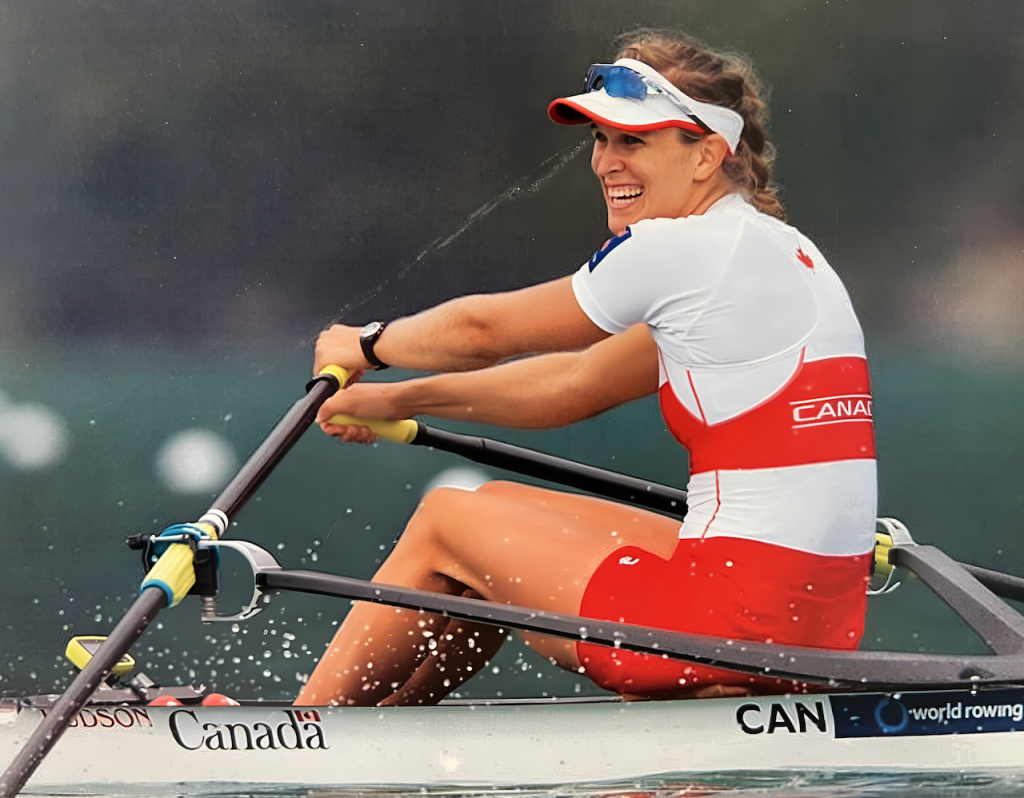
In 2016, Cambridge’s Carling Zeeman, a top Canadian medal hopeful, battled windy conditions on her first day of competition at the Rio Olympics to easily win her heat in the women’s single sculls preliminary races and advance to the quarterfinals at Lagoa Stadium. It was her first Olympic Games.
The 25-year-old, winner of the 2015 Cambridge Athlete of the Year, won her heat in a time of 8:41.12, with the top three in each heat advancing.
She had transitioned to the single scull from the quad in 2015. That season she qualified the single for Canada at a competition in France, ensuring that Canada would enter a single scull at the Rio Olympics the following year. But she still had to qualify at the Canadian Trials to compete at Rio the next year. She not only competed, but won, ensuring her a spot at Rio.
Winning a World Cup race in Italy during the leadup to Rio was a career highlight, even though the Canadian coach wanted to move her from singles to the eight.
She went on to place ninth at Rio in 2016, and five years later, finished eighth at the Tokyo Olympics in 2021.
That first Olympic experience, at Rio, was memorable.
“There was quite a bit of pressure that first time,” she admitted. “There was a lot of media attention on how I was the first single (sculler) since Silken, and, how I could never live up to Silken’s legacy and whatnot. So that was really a bit of a shadow that I lived in for that year. I don’t think that’s very helpful. I ended up coming ninth. I was disappointed with that. When one trains as much as we train to come ninth, it’s disappointing. But overall, it was a fantastic experience.”
Silken Laumann won multiple Olympic medals during her career, including a bronze at the 1992 Olympics after a devastating leg injury leading up to the Games. There, she was selected to carry the Canadian Flag in the closing ceremonies, and in 1996 capped off her career with a silver medal at the Atlanta Olympics.
Despite her disappointment on the water at the time, Zeeman was able to soak up the Olympic experience. “My entire family came, and some friends, and… Wow. It was just such an awesome, awesome time, and, because rowing’s in the first week of the Games, I had the entire second week to just enjoy and watch other Canadian Olympians do their thing.”
She was also able to attend the closing ceremonies.
Following Rio she moved to Victoria (Elk Lake) with the rest of the women’s national team, which had previously been based in London, Ontario.
“The men were always in Victoria, but the women were in London, and after Rio, the head coach was fired, and we got a new head coach who had some great ideas. Victoria’s a natural choice because the water doesn’t freeze. London would freeze from December until maybe March, and we would end up spending a lot of money going to Florida every two weeks to train.”
That first year in Victoria she trained with the women’s national team, but there were problems for Zeeman with the head coach. “If I’m honest, he was just awful,” she said. He was subsequently fired. Victoria was not only temperate, but beautiful, and offered year-round rowing, cycling and running. The Canadian Sport Institute is also based in Victoria.
“That’s a really awesome resource. We can do our weight training and erg (rowing ergometer) sessions there, and we’ve got a whole bunch of physiologists on deck.”
At the 2017 World Championships Zeeman rowed to a sixth-place finish.”It was quite disappointing,” she relates. “I really was butting heads with the head coach a lot, and so after the World Championships, I stepped away. I just more or less handed in my letter of resignation.”
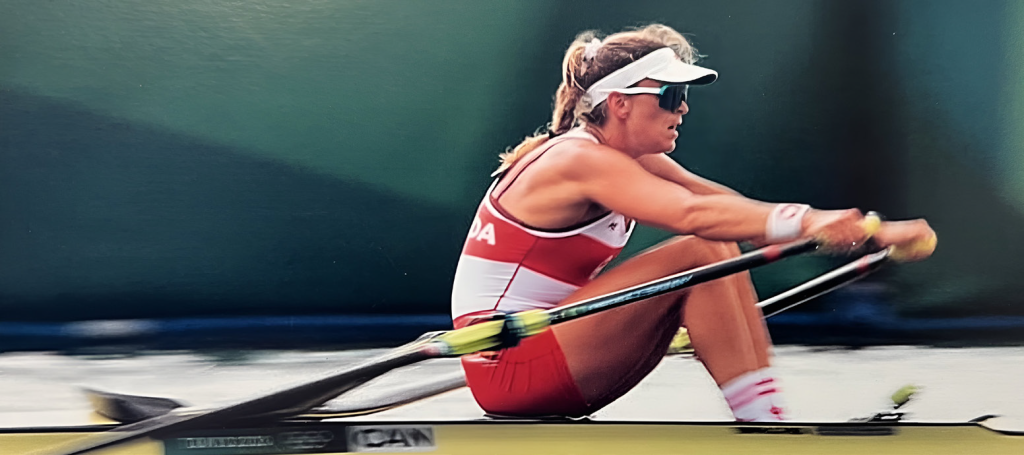
Her resignation didn’t last long. When she returned, she began training with the men’s team. It meant she could continue to grow.
Each year there were three World Cups, and other races in Europe, where she added to her World Cup gold from 2016 with two more medals, a silver and bronze.
“And I ended up qualifying the woman single again in 2019 for the 2020 Tokyo Olympics.” That was in Linz, Austria.
The 2020 Olympics, where she placed eighth, were delayed a year due to COVID-19. But on the verge of those Games she broke some ribs while rowing, an all-too-common injury for world-class rowers. The recovery time didn’t help her get ready for the Olympics, yet she came back to compete at the Games.
During that COVID year she drove back to Cambridge from Victoria, bringing along her rowing erg, and her husky dog Lola. She spent a month or two at her parent’s home.
She got out to row again on Guelph Lake, not on the Grand, where the Cambridge Rowing Club is based. She had no real connection with the Cambridge club, having only started her rowing career after she went north to Sudbury to attend Laurentian University following her high school days at Cambridge’s Woodland Christian High School—she earlier attend Cambridge Christian School.
“I didn’t know rowing existed until I went to Laurentian.” And even then, it was only by chance that she got started in the sport. Although she was a talented high school athlete—she was also a good speed skater, along with her four siblings, with the Cambridge Speed Skating Club— she thought her athletic days were behind her when she went to Laurentian.
Her parents, having a Dutch background, were eager to take advantage of the local speed skating club, where the late Ernie Overland was a coach. “My parents got me into the sport but Ernie kept us in it.”
In Sudbury—she graduated from the Outdoor Adventure Leadership Program—she went to a learn-to-row program, where her height (over six feet) and strength caught the attention of the coach.
“I wanted to try something different. I rowed for that first year as a novice.” The coach told her “we’ve got a training program for you, and we can get you on this trajectory to make the junior national team.” But she was intent on rowing on her own terms, not following someone else’s agenda. She made a pledge to herself that the second she stopped enjoying it, “I would just quit. And it’s now 2026 and I am still rowing because I love it.
I just love it.”
Her rowing career has included a long list of triumphs in Canada and on the world stage, beginning in 2013 when she was the Canadian University Rowing Association’s Female Athlete of the Year and Rowing Canada’s Female Sculler of the Year. It’s been a long journey that began with the National Team in 2012. She’s still trying to find her limits. And when she’s not rowing, she works as a paramedic.
Through it all there have been many ups, and downs. “Rowing has taken me to some pretty incredible places. It’s
been such a great opportunity.”
Her most memorable race? It might not have been while representing Canada, although there have been several of those races throughout her career. No, it might just be the race she and a friend rowed up the Inside Passage to Alaska a few years ago.
“It was incredible. We’re doing this in a small wooden rowing boat, and waves are just crashing over you, and the
boat, the bailer is trying to keep up, but one wave comes in after another, and you’re completely submerged.”
It took two weeks, from Port Townsend, to reach Ketchican, Alaksa. They finished on July 2, 2022. She was spent.
They took a comfortable ferry back down the Inside Passage. But she’ll never forget those two weeks.
“I was very afraid. I don’t think I’ve ever been afraid, like that.”